


 English

How Does a Brushless Motor Work?
Brushless motors have become an essential power solution in modern industrial equipment, automotive systems, robotics, medical devices, and consumer electronics. Compared with traditional brushed motors, a brushless motor provides higher efficiency, longer service life, lower maintenance requirements, and improved performance.
But how does a brushless motor work? Unlike brushed motors that use mechanical brushes and a commutator to control current flow, a Brushless Dc Motor uses electronic control technology to achieve precise motor operation.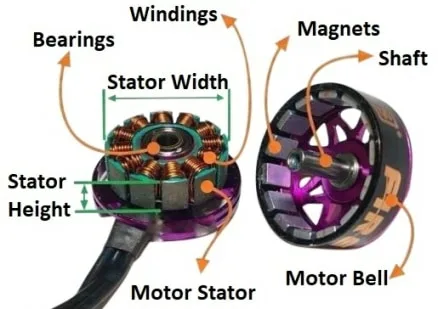
What Is a Brushless Motor?
A brushless motor, also known as a Bldc Motor (Brushless DC Motor), is an electric motor that uses electronic commutation instead of mechanical brushes to generate rotation.
The main components of a brushless motor include a rotor with permanent magnets, a stator with electromagnetic coils, and an electronic controller. These components work together to convert electrical energy into mechanical motion.
How Does a Brushless Motor Work?
The working principle of a brushless motor is based on the interaction between magnetic fields generated by the stator and permanent magnets inside the rotor.
When electrical current passes through the stator windings, it creates a rotating magnetic field. The permanent magnets on the rotor respond to this magnetic field and begin to rotate, producing mechanical movement.
The electronic controller continuously switches the current direction in the stator coils, allowing the magnetic field to rotate smoothly and maintain continuous motor operation.
Main Components of a Brushless DC Motor
1. Rotor
The rotor is the rotating part of a brushless motor. It usually contains permanent magnets that interact with the magnetic field generated by the stator.
2. Stator
The stator contains copper windings that create electromagnetic fields when electrical current passes through them. These magnetic fields drive the rotor rotation.
3. Electronic Controller
The electronic controller replaces the brushes and commutator found in traditional motors. It controls current switching and determines motor speed, direction, and torque.
4. Sensors
Many brushless motors use Hall sensors or sensorless control systems to detect rotor position and improve motor control accuracy.
Brushless Motor Working Principle
The bldc motor working principle follows a simple process:
The controller supplies electrical current to the stator coils.
The stator creates a rotating magnetic field.
The rotor magnets follow the magnetic field and rotate.
The controller continuously adjusts current switching to maintain rotation.
Mechanical output is produced through continuous rotor movement.
Brushless Motor vs Brushed Motor
| Feature | Brushless Motor | Brushed Motor |
|---|---|---|
| Commutation | Electronic control | Mechanical brushes |
| Efficiency | Higher efficiency | Lower efficiency |
| Maintenance | Low maintenance | Brush replacement required |
| Service Life | Longer lifespan | Shorter lifespan |
| Noise | Lower operating noise | More mechanical friction |
Advantages of Brushless Motors
Higher Efficiency
Because brushless motors eliminate friction caused by brushes, they provide improved energy efficiency and better power utilization.
Longer Service Life
Without mechanical brushes that wear over time, brushless motors can operate for longer periods with reduced maintenance requirements.
Better Speed and Torque Control
Electronic control allows precise adjustment of motor speed, torque, and operating performance.
Compact and Reliable Design
Brushless motors provide high power density, making them suitable for applications where size and reliability are important.
Applications of Brushless Motors
Due to their high efficiency and reliable performance, brushless motors are widely used in many industries, including:
Automotive systems
Robotics and automation equipment
Drones and aerospace devices
Medical equipment
Power tools
Industrial machinery
Consumer electronics
Why Choose a Custom Brushless Motor?
Different applications require different motor specifications, including voltage, speed, torque, size, and operating environment. A custom brushless motor allows manufacturers to optimize motor performance according to specific product requirements.
Professional brushless motor manufacturers can provide customized solutions for industries requiring reliable and efficient motor systems.
Conclusion
So, how does a brushless motor work? A brushless motor uses electronic commutation and magnetic interaction between the stator and rotor to produce smooth and efficient rotation. Compared with traditional brushed motors, BLDC motors offer better efficiency, longer lifespan, and improved control performance.
For applications requiring reliable motor solutions, choosing the right brushless motor manufacturer can help achieve better performance, lower maintenance costs, and improved product reliability.