


 English

No — a microneedling cartridge is a single-use consumable, and the reason is not the needle tip. A used cartridge holds serum, blood residue and skin cells inside a housing that cannot be opened, cleaned or re-sterilized by a salon. The needle bed sits behind a plastic collar and a spring assembly, so anything that reaches the needles also has to survive contact with the mechanism. In practice, reusing a cartridge trades a low consumable cost for a much larger clinical and legal risk. This guide explains what actually fails on a reused cartridge, which sterilization methods damage the device, and how to check whether a supplier is really shipping sterile, traceable stock.
Why a microneedling Cartridge Is Built for Single Use
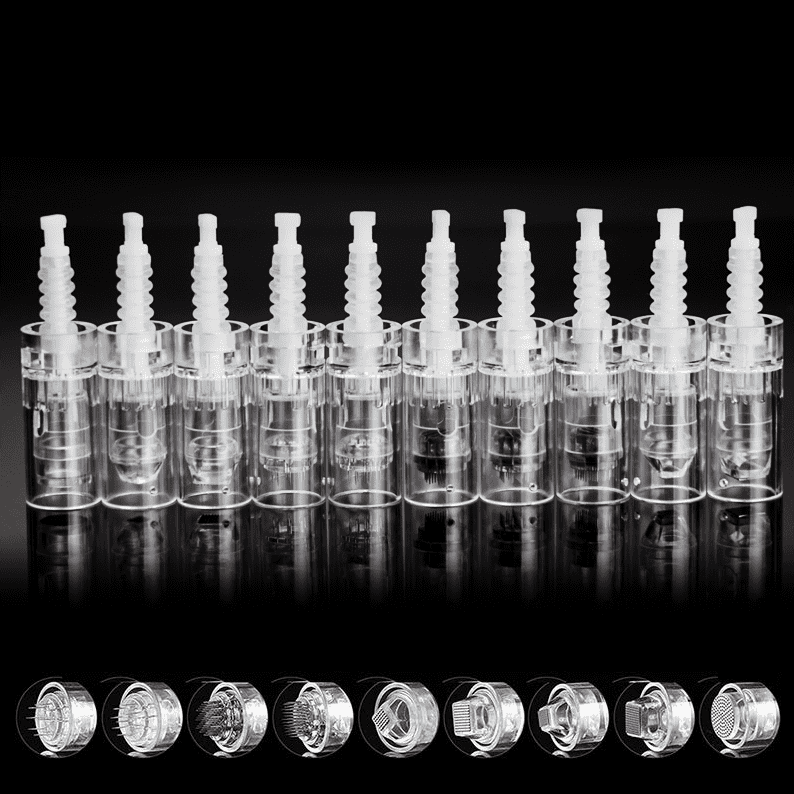
A cartridge is a sealed mechanical assembly, not a bare needle. The needle tip, the reservoir and the delivery mechanism are enclosed in an ABS housing, and the whole unit is packed individually so that the sterile barrier stays intact until the seal is opened. Our own microneedle cartridges are built this way: a stainless steel needle tip, an individually packed disposable unit with a protective cap, and a shell that is not designed to be opened for cleaning.
That design has two consequences for anyone planning to reuse stock. First, the parts that contact biological material — the needle channels and the reservoir — are the parts you can least reach. Second, the plastic and spring components are the parts least able to tolerate a sterilization cycle. A cartridge is therefore consumed by design, and its cost is calculated into the treatment price, not amortized across sessions.
What Actually Goes Wrong When a Cartridge Is Reused
Reuse does not fail in one dramatic way. It degrades along several independent paths at once, and the damage is often invisible until a client reacts.
| Reuse cycle | What is happening to the cartridge | Practical consequence |
|---|---|---|
| Second use | Residue from the first session is still inside the needle channels and reservoir. The sterile barrier is already broken. | Residual product is pushed into the next client's skin along with anything it carried. |
| Third to fifth use | Needle tips blunt and can bend. Blunted tips require more passes and more pressure for the same effect. | More trauma per session, longer downtime, and results that become inconsistent between clients. |
| Any use after a chemical soak | Disinfectant reaches the outer housing but not the needle bed. Some agents leave residue that is itself an irritant. | The cartridge looks clean and is not clean — the hardest failure mode to detect visually. |
| Any use after heat sterilization | Heat and pressure deform the housing and weaken the spring. The needle depth setting no longer matches the dial. | The operator believes the device is at 0.5 mm when it is not, which is a depth-control failure, not just a hygiene failure. |
The fourth row is the one most often overlooked in purchasing discussions. Depth accuracy depends on the mechanical integrity of the cartridge, so a cartridge that has been through a heat cycle can be simultaneously non-sterile and mechanically out of specification. If your brand sells a device with a depth dial, a deformed cartridge is also a product-claims problem.
Can You Sterilize a Microneedling Cartridge Yourself?
This is the question salons ask most often, and the honest answer depends on which method is being considered. None of the three common options is a substitute for a new cartridge.
Autoclave (steam under pressure)
An autoclave is designed for instruments that tolerate high temperature and moisture. A cartridge housing is molded plastic with a spring inside, so the cycle tends to deform the geometry and weaken the mechanism. Even where the unit survives visually, the depth reference and the needle alignment may no longer be trustworthy.
Chemical disinfection
A soak reaches surfaces the liquid can touch. Inside a cartridge, that excludes the needle channels and the reservoir, which are the areas that matter. Chemical agents also leave residue on a device that is about to be pressed into skin.
UV cabinets
UV is a line-of-sight process. It does not penetrate the plastic shell, and it does not remove residue. It is useful for surface hygiene on instruments, not for resterilizing a used consumable.
The practical takeaway: in-salon microneedle cartridge sterilization is not a way to extend cartridge life. It is a way to manage everything else in the treatment room. If cost per treatment is the real concern, the lever is cartridge specification and order volume, not reuse — our guide to cleaning a micro needle roller covers what routine hygiene does and does not accomplish.
How to Choose a Microneedling Cartridge Manufacturer
Because a used cartridge and a fresh one look identical, the assurance has to come from the packaging and the paperwork rather than from inspection of the product itself. When you evaluate a sterile microneedling cartridge supplier, ask for these six items before placing a bulk order.
| Check | What a good answer looks like | Red flag |
|---|---|---|
| Sterile barrier packaging | Each cartridge individually packed with a protective cap, peelable and intact | Cartridges supplied loose in a bag with no individual seal |
| Batch and lot marking | A lot number on the outer box that lets you trace a complaint back to a production run | No lot code anywhere, or a code that changes without explanation |
| Shelf life and storage | A stated expiry and a storage condition the packaging actually supports | No date at all, or dates that get reprinted on request |
| Specification consistency | Needle count and length stated per SKU and confirmed in the inspection report | "12 needles" on the box, a different count on arrival |
| Quality documentation | A quality inspection report you can review, and certification documents where your market requires them | Certificates shown only as screenshots, never as documents with a scope |
| Seal integrity on arrival | A sample check of the carton before the stock goes into the treatment room | Accepting a shipment without opening a single unit |
Note that requirements differ by market. Device classification, labeling language and the documentation a distributor must hold vary by country, so confirm the applicable rules for your territory rather than assuming a single global standard. What does not vary is the traceability expectation: if you cannot identify the batch, you cannot respond to a client complaint in a defensible way.
Needle Count and Depth: What to Stock for Your Market
Once single-use supply is settled, the next decision is the SKU mix. Stocking too many needle configurations raises dead inventory; stocking too few limits what the treatment room can offer. Specifying the microneedling cartridge needle count for each line item matters as much as specifying the depth, because the two together define what a treatment protocol can actually do. These are the ranges we build to most often.
| Needle count | Typical use | Stocking note |
|---|---|---|
| 9 / 12 needles | Small areas and controlled, higher-depth work | Lower volume, but expected by professional users |
| 24 / 36 needles | General facial treatment, the volume SKU for most salons | Usually the highest-turn item — stock deepest here |
| 42 needles and nano series | Large-area, shallow passes and non-invasive infusion | Growing demand in the home-use and retail channel |
| 0.25 / 0.5 / 1.0 mm | The standard depth ladder for cartridge-based devices | Depth range matters more than depth count for perceived results |
Cartridge SKUs are also the natural place to add your own branding, since the packaging is small and inexpensive to customize. A custom microneedle cartridge brief is normally cheaper to fulfil than a full OEM project, because the needle assembly platform already exists and only the count, depth and packaging have to change. Our facial microneedles and the wider derma needle range are both supplied with custom needle counts and packaging, and the same cartridges can be bundled with a pen for a complete retail kit — the logic behind choosing between nano needling and microneedling for a brand's first device.
If your customers are mostly home users rather than clinics, the cartridge conversation shifts toward simpler depth options and clearer instructions. Our overview of how to use a microneedle roller and the guide to what a microneedle roller is cover that side of the market.
Frequently Asked Questions
Can you reuse microneedling cartridges?
They are supplied and labeled as single-use consumables, and there is no practical way to restore a used cartridge to a sterile state. The residue sits in channels you cannot reach, and the mechanical parts do not tolerate a sterilization cycle. Treat the cartridge as a cost per treatment.
How many times can a microneedling pen cartridge be used?
One session per cartridge. If a treatment covers several zones, use a fresh cartridge per client rather than per zone where contamination is possible, and never carry a cartridge between clients.
Does a cartridge need to be sterile if it is only used on intact skin?
Microneedling creates controlled micro-channels, which is a breach of the skin barrier by definition. The sterile presentation is part of what makes the treatment predictable, so the requirement stands regardless of how superficial the pass is.
What needle count should I order first?
Start with the 24 and 36 needle configurations in 0.5 mm, then add 0.25 mm and a nano SKU once you see which treatment protocols your customers actually run. Ordering the full grid up front usually leaves slow-moving inventory.
Can the packaging be customized for our brand?
Yes. Individual sachets, blister cards and outer boxes can all carry your artwork, and the needle count or depth printed on the packaging can be matched to your SKU list. Send the specification and we will confirm what the packaging tooling requires.
Build Your Cartridge Program with Ruige
Huizhou Ruige Electromechanical Technology manufactures nano delivery devices, microneedling tools and microneedle consumables from our own facility in the Pearl River Delta. Cartridges are produced to your needle count and depth specification, individually packed with a protective cap, and shipped with a quality inspection report; our Nano Pen platforms carry CE, FCC and RoHS documentation. If your market requires additional certification or labeling, tell us the territory and we will confirm what applies before you commit to tooling.
Next step: send your needle count, depth range, packaging requirement and target annual volume to lavender@xiangnaierelectromechanical.com, or request a quotation through our contact page. Our team will come back with a specification confirmation, sample lead time and pricing.