


 English

Yes, brushed DC motors may require regular cleaning and inspection, particularly around the carbon brushes, commutator, brush holder, and ventilation openings. Unlike a Brushless Dc Motor, a brushed motor uses mechanical contact between carbon brushes and a commutator to transfer electrical current. This contact naturally produces friction, wear, and carbon dust during operation.
For this reason, routine maintenance is an important part of operating a brushed DC motor reliably. Proper cleaning does not simply mean removing dust from the outside of the motor. It involves inspecting the brush system, maintaining the commutator condition, keeping ventilation paths clear, and identifying abnormal wear before it causes motor performance problems.
Why Do Brushed DC Motors Need Cleaning?
A brushed DC motor relies on mechanical commutation. Carbon brushes continuously contact the rotating commutator while the motor is operating.
Over time, this process can produce:
Carbon brush dust
Wear particles
Commutator residue
Electrical arcing deposits
General dust and contamination
If these materials accumulate inside the motor, they can interfere with brush movement, electrical contact, heat dissipation, and overall motor performance.
This is one of the fundamental differences between brushed and Brushless Motor designs. A brushless DC motor replaces mechanical commutation with electronic switching, eliminating the physical brush-to-commutator contact. As a result, brushless motors generally require less routine maintenance associated with brush wear. The basic operating difference is also explained in How Brushless Motor Works.
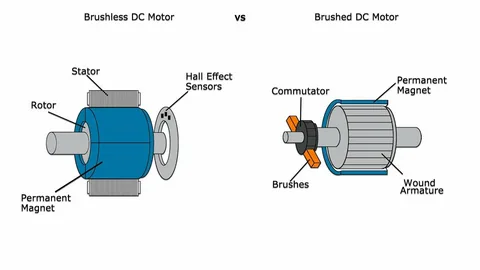
Which Parts of a Brushed DC Motor Need Attention?
Cleaning should focus on areas that directly influence electrical contact, mechanical movement, and heat dissipation.
Carbon Brushes
Carbon brushes gradually wear as they operate against the commutator. The resulting carbon dust can accumulate around the brush assembly.
During maintenance, technicians should inspect:
Brush length
Brush surface condition
Uneven wear
Brush movement inside the holder
Spring pressure
Excessive carbon dust
Signs of overheating or arcing
A brush that is significantly worn should not simply be cleaned and returned to service. It may need to be replaced according to the motor manufacturer's specifications.
Commutator
The commutator is another critical maintenance point.
A healthy commutator should have a suitable contact surface for the brushes. Excessive deposits, abnormal discoloration, deep grooves, pitting, or signs of severe arcing may indicate a problem that requires further inspection.
Routine cleaning can remove loose contamination, but mechanical damage should not be treated as a simple cleaning issue. If the commutator is significantly worn or damaged, professional servicing may be required.
Brush Holder
Carbon dust can accumulate around the brush holder and restrict brush movement.
The brush must be able to move correctly within the holder so that it maintains appropriate contact pressure against the commutator. A contaminated or damaged brush holder can therefore contribute to unstable electrical contact.
Ventilation Openings
Motor cooling is also important.
Dust accumulation around ventilation openings can restrict airflow and reduce heat dissipation. Higher operating temperatures can accelerate insulation aging and affect motor reliability.
For motors operating in dusty industrial environments, ventilation areas should be inspected more frequently.
How Often Should a Brushed DC Motor Be Cleaned?
There is no universal cleaning interval that applies to every brushed DC motor.
The appropriate maintenance frequency depends on:
Motor operating hours
Load conditions
Operating speed
Brush material
Brush wear rate
Dust concentration
Ambient temperature
Humidity
Ventilation
Duty cycle
Consequences of motor failure
A motor operating continuously in a clean environment may require less frequent internal cleaning than one operating in a dusty manufacturing environment.
Instead of relying only on a fixed calendar interval, many industrial applications benefit from a condition-based maintenance approach.
For example, maintenance personnel can monitor brush wear, commutator condition, operating temperature, unusual noise, vibration, and visible arcing. The inspection interval can then be adjusted according to actual operating conditions.
A Practical Brushed DC Motor Maintenance Process
A professional maintenance procedure can be divided into several stages.
Step 1: Disconnect the Power
Always disconnect the motor from its power source before inspection or cleaning.
The motor should be fully stopped, and appropriate electrical isolation procedures should be followed.
Step 2: Inspect the Exterior
Check the motor housing, ventilation openings, terminals, cables, and mounting points.
Remove external dust and contamination using a suitable dry cleaning method specified for the motor.
Step 3: Inspect the Carbon Brushes
Check brush length and wear pattern.
If one brush is wearing substantially faster than another, the problem should be investigated rather than simply replacing the worn brush.
Uneven wear may indicate problems involving brush alignment, spring pressure, commutator condition, vibration, or mechanical loading.
Step 4: Inspect the Commutator
Check for:
Excessive carbon deposits
Uneven surface wear
Pitting
Grooves
Burn marks
Abnormal discoloration
Excessive sparking evidence
Minor contamination may be addressed according to the manufacturer's maintenance procedure. More serious surface damage should be evaluated by qualified personnel.
Step 5: Remove Carbon Dust
Carbon dust should be removed using a cleaning method appropriate for electrical equipment.
Do not simply spray water into the motor.
Water or unsuitable cleaning fluids can damage insulation, bearings, electrical connections, and other internal components.
The manufacturer's service instructions should always take priority when selecting a cleaning method.
Step 6: Check Bearings and Mechanical Components
Although bearings are not part of the brush system, they should also be checked during scheduled maintenance.
Unusual noise, vibration, shaft movement, or increased operating temperature can indicate bearing wear or another mechanical problem.
Step 7: Reassemble and Test
After maintenance, ensure all components are correctly installed before reconnecting power.
The motor should then be checked for abnormal noise, vibration, temperature rise, current consumption, and excessive sparking.
What Happens If a Brushed DC Motor Is Not Maintained?
Insufficient maintenance can gradually affect both performance and service life.
Excessive carbon dust may interfere with electrical contact. Worn brushes can increase arcing and reduce commutation quality. A damaged commutator can accelerate brush wear, creating a cycle of increasing contamination and electrical instability.
Other symptoms may include:
Increased electrical noise
Excessive sparking
Reduced motor efficiency
Unstable speed
Increased operating temperature
Unusual vibration
Intermittent operation
Shortened brush life
These symptoms should not automatically be attributed to dirty brushes. Problems with the power supply, controller, mechanical load, bearings, commutator, or motor winding can produce similar symptoms.
When Should Carbon Brushes Be Replaced?
Cleaning and replacement are two different maintenance actions.
Carbon brushes should be replaced when they reach the manufacturer's minimum allowable length or show abnormal damage.
Replacement may also be necessary when there is:
Excessive brush wear
Cracking
Chipping
Uneven contact
Burn damage
Weak or damaged springs
Abnormal sparking
When replacing brushes, the replacement specification should match the motor design. Using an unsuitable brush material or incorrect brush dimensions can negatively affect commutation and accelerate wear.
Can You Clean a Brushed DC Motor With Water?
Generally, you should not use water to directly clean the inside of a standard brushed DC motor unless the motor is specifically designed for that cleaning method and the manufacturer permits it.
A motor contains electrical insulation, bearings, brush assemblies, and other components that may be affected by moisture.
For routine maintenance, use the cleaning method specified by the motor manufacturer. External surfaces can generally be cleaned more easily, but internal cleaning requires greater care.
The key principle is simple:
Remove contamination without introducing moisture or chemicals that can compromise electrical or mechanical components.
Brushed DC Motor vs. Brushless DC Motor Maintenance
The maintenance requirements are one of the practical differences between these two motor technologies.
| Feature | Brushed DC Motor | Brushless DC Motor |
|---|---|---|
| Mechanical Brushes | Yes | No |
| Mechanical Commutator | Yes | No |
| Brush Wear | Yes | No |
| Carbon Dust | Possible | No brush-generated carbon dust |
| Brush Replacement | Required when worn | Not applicable |
| Electronic Commutation | No | Yes |
| Routine Brush Maintenance | Required | Not required |
| Typical Maintenance Focus | Brushes, commutator, bearings, ventilation | Bearings, electronics, sensors, ventilation |
Brushless motors are therefore attractive for applications where reduced mechanical wear and lower routine maintenance are important. However, this does not mean that a Bldc Motor requires no maintenance at all. Bearings, connectors, sensors, controllers, cooling systems, and mechanical components can still require inspection depending on the application.
The working principle and main components of bldc motors are discussed in more detail in How Brushless Motor Works.
How the Operating Environment Changes Maintenance Requirements
The same motor may require very different maintenance intervals in different environments.
Clean Electronics Equipment
Motors operating inside relatively clean equipment may accumulate less external contamination. Routine inspection can often be based on operating hours and manufacturer recommendations.
Industrial Manufacturing
Industrial machinery may expose motors to dust, particles, oil mist, vibration, and continuous operation. In these environments, inspection frequency should generally be increased.
High-Dust Environments
Dust can accumulate around ventilation openings and brush assemblies more quickly. Condition monitoring and regular cleaning become particularly important.
High-Temperature Applications
High temperatures can accelerate brush and insulation aging. Motor temperature should therefore be monitored together with brush condition.
Maintenance Is More Than Cleaning
A common mistake is to treat motor maintenance as simply removing dust.
For a brushed DC motor, effective preventive maintenance should combine:
Cleaning + Brush Inspection + Commutator Inspection + Mechanical Inspection + Electrical Testing
This approach provides a much better indication of motor condition than cleaning alone.
If a motor begins producing excessive sparks, overheating, losing torque, or operating at an unstable speed, cleaning should not be assumed to be the complete solution. The root cause should be identified before the motor is returned to continuous operation.
Conclusion
A brushed DC motor does require periodic cleaning and inspection, particularly because carbon brushes naturally wear during operation and generate dust. The carbon brushes, commutator, brush holder, and ventilation openings are the primary areas that require attention.
However, there is no single cleaning interval suitable for every motor. A better maintenance strategy considers operating hours, environmental conditions, load, speed, brush wear, temperature, and the manufacturer's maintenance recommendations.
For manufacturers and equipment users, regular inspection can identify brush wear, commutator problems, overheating, and contamination before they develop into more serious motor failures.
For applications where minimizing brush wear and routine maintenance is a priority, brushless DC motors offer a different architecture based on electronic rather than mechanical commutation. This is one reason BLDC motors are widely used in automation, robotics, compact equipment, and other applications requiring long operating life and reduced maintenance.