


 English

A high torque Brushless Dc Motor (BLDC) is a high-performance permanent magnet synchronous motor driven by electronic commutation. It is specially designed to output strong torque at low speed while maintaining high efficiency, long service life and stable performance. It is widely used in industrial equipment, power tools, robots, automotive systems and intelligent machinery that requires heavy load starting and stable driving.
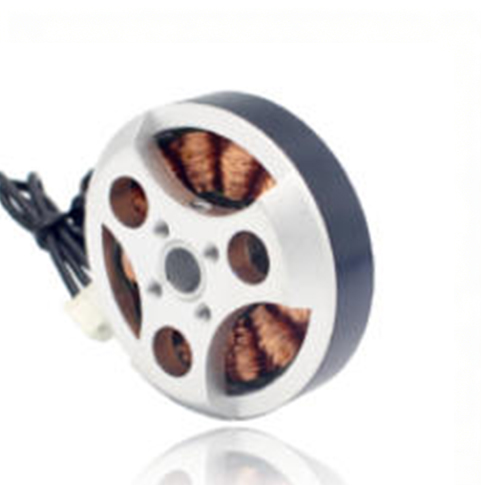
Working Principle of High Torque Brushless DC Motor
The high torque Bldc Motor realizes operation through precise electronic commutation instead of mechanical brushes. The working process follows a complete and stable flow:
1. The stator winding is powered on to generate a rotating magnetic field, which interacts with the permanent magnet rotor to generate driving force;
2. The rotor position is detected in real time by Hall sensors or back EMF to ensure accurate commutation;
3. The driver adjusts current and phase to maintain stable torque output even at low speed;
4. The electronic control system suppresses torque ripple and ensures smooth operation under heavy load conditions.
This structure eliminates friction loss caused by brushes, allowing the motor to maintain high torque output for a long time without rapid wear, greatly improving reliability and durability.
Core Advantages of High Torque Brushless DC Motor
High torque at low speed: Provides strong instantaneous torque during startup, suitable for heavy-load starting and low-speed driving scenarios.
High efficiency & energy saving: Efficiency up to 85%–90%, converting more electrical energy into mechanical power and reducing energy consumption.
Long service life: No brush wear, fewer moving parts, low failure rate and long continuous working time.
Quiet operation: No friction noise from brushes, low vibration, ideal for noise‑sensitive equipment.
Precise control: Stable torque and speed adjustment, supporting high‑precision motion control.
Key Technical Parameters & Explanations
| Model | BE3506 |
| RPM/KV | 79KV |
| Voltage | 18V |
| Max Power | 1.584W |
| Max Current | 0.09A |
| Weight | 58g |
| Motor Size | Φ42×20.5mm |
| Shaft Diameter | Φ12mm |
KV Value: Low KV value means high torque and low speed, which is the core feature of high torque bldc motors.
Voltage: Stable working voltage to ensure continuous torque output and safe operation.
Max Power & Current: Reflect the load capacity and output capacity of the motor.
Shaft Diameter & Size: Mechanical dimensions for installation and application matching.
Typical Applications
High Torque Brushless DC Motor: Working Principle, Features, Applications, and Maintenance
Working Principle
The high torque brushless DC (BLDC) motor operates on the principle of electronically controlled commutation, eliminating the need for mechanical brushes. The rotor, typically made of permanent magnets (e.g., neodymium or ferrite), is driven by a stator with concentrated windings. A controller (often using Hall effect sensors or sensorless back-EMF feedback) precisely energizes the stator phases in sequence. This creates a rotating magnetic field that pulls the rotor along. For high torque output, the motor is designed with a larger number of poles (e.g., 12–20 poles) and a high magnetic flux density (typically 0.8–1.2 T). The torque is generated by the Lorentz force: T = k × Φ × I, where k is the motor constant, Φ is the magnetic flux, and I is the current. In high-torque BLDC motors, the air gap is minimized (0.5–1.5 mm) to maximize flux linkage, and the winding resistance is kept low (<0.1 Ω) to support high current (up to 100–200 A peak). The controller uses pulse-width modulation (PWM) at frequencies of 20–40 kHz to smooth current ripple and improve efficiency (typically 85–95%).
Key Features with Professional Data
1. High Torque Density
High torque BLDC motors achieve torque densities of 0.5–1.5 Nm/kg, compared to 0.2–0.4 Nm/kg for brushed motors. For example, a 1 kW high-torque BLDC can produce 5–10 Nm continuous torque at 1500 RPM, with a peak torque of 15–20 Nm for short durations (≤10 seconds). The torque constant (Kt) ranges from 0.1 to 0.5 Nm/A, depending on magnet strength and winding configuration.
2. Wide Speed Range
These motors operate from 0 to 10,000 RPM (or higher) with constant torque up to rated speed (e.g., 3000 RPM), then constant power region up to 6000–8000 RPM. The speed regulation is better than ±1% under varying loads, thanks to closed-loop control with encoder (resolution 1000–5000 pulses/rev) or Hall sensors (accuracy ±2° electrical).
3. High Efficiency
Efficiency curves show peak values of 92–96% at 50–80% rated torque and 70–90% rated speed. No-load current is very low (0.5–2% of rated current). The motor’s iron losses (hysteresis and eddy current) are minimized using laminated silicon steel (0.2–0.5 mm thickness) with low loss coefficient (e.g., 35W300 grade). Copper losses account for 60–70% of total loss at full load.
4. Compact Size and Low Weight
Frame sizes are typically 80–130 mm diameter for 500–2000 W units, with lengths of 80–200 mm. Weight-to-power ratio is 0.15–0.25 kg/kW, enabling integration into space-constrained robotics, e-bikes, and industrial actuators.
5. Low Maintenance and Long Life
With no brushes, the only wear components are bearings (rated for 10,000–20,000 hours at rated load). Insulation class H (180°C) or F (155°C) allows operation in ambient temperatures up to 60–80°C. Ingress protection (IP54–IP67) is available for dusty or wet environments.
6. Smooth Torque Output
Cogging torque is reduced to <1–3% of rated torque through skewed rotor magnets (by 0.5–1 slot pitch) or fractional slot winding (e.g., 12 slots/10 poles). Torque ripple is typically <2–5% at rated speed, ensuring vibration-free operation in precision positioning systems.
7. Fast Dynamic Response
Mechanical time constant (τm) is 5–15 milliseconds, and electrical time constant (τe) is 0.5–2 milliseconds. This enables acceleration rates of 10,000–50,000 rad/s², crucial for servo applications like CNC spindles or robotic arm joints.
Application Scenarios
1. Industrial Automation and Robotics
High torque BLDC motors drive collaborative robot joints (e.g., KUKA, Universal Robots) with payloads up to 20 kg. They provide precise angular control (±0.01°) and continuous torque of 2–10 Nm. In conveyor systems, they replace induction motors with direct drive, eliminating gearbox backlash, achieving 30% energy savings.
2. Electric Vehicles (EVs) and E-Bikes
For e-bikes, hub motors (250–750 W) deliver 40–80 Nm peak torque for hill climbing (20% grade). Electric scooters and motorcycles (2–10 kW) use mid-drive BLDC motors with torque up to 150–200 Nm, achieving 50–80 km/h speeds. In EVs, BLDC traction motors (50–200 kW) produce 200–500 Nm instant torque, enabling 0–100 km/h in under 5 seconds.
3. Medical Equipment
Surgical robots (e.g., da Vinci system) require high torque density (0.5 Nm from a 20 mm diameter motor) and smooth motion (ripple <1%). MRI-compatible BLDC motors (non-magnetic materials) operate in strong magnetic fields, providing 0.1–1 Nm for robotic arms.
4. Aerospace and Drones
UAVs (drones) use high-torque outrunner BLDC motors (500–1000 W, 100–200 g) to lift 1–5 kg payloads. Efficiency >90% extends flight time to 30–60 minutes. In satellite reaction wheels, low-cogging motors (torque ripple <0.1%) maintain attitude control with micro-Nm precision.
5. Renewable Energy Systems
Wind turbine yaw and pitch control use BLDC motors (1–10 kW, 100–500 Nm) to adjust blade angles in 10–20 knot winds, surviving 100,000+ cycles. Solar tracking systems employ them for azimuthal rotation (0.1° accuracy) under extreme weather (−20°C to +60°C).
6. Home Appliances and Power Tools
High-end vacuum cleaners (150–300 W) have BLDC motors spinning at 100,000–120,000 RPM, providing 20–40% more suction than brushed types. Cordless drills and impact wrenches (600–1200 W) deliver 50–180 Nm peak torque, with electronic torque limiting for fastener control.
Maintenance Guidelines
1. Cleaning and Inspection
Every 500–1000 operating hours, clean motor surfaces using compressed air (≤3 bar) to remove dust, especially from cooling fins and fan blades (if present). For IP54-rated motors, avoid water jets; use a dry cloth. Inspect for vibration (use accelerometer: threshold 2–5 mm/s RMS) and unusual noise (spectral analysis: peaks at bearing fault frequencies 3–10 kHz).
2. Bearing Care
Sealed bearings (e.g., 6202-2RS) require no re-greasing, but open bearings need grease replenishment every 2000–3000 hours. Use lithium-complex grease (NLGI grade 2) of 20–30 g per bearing. Replace bearings when axial play exceeds 0.1–0.2 mm or radial play exceeds 0.05 mm. Running temperature <70°C is normal; above 90°C indicates overload or bearing damage.
3. Electrical Connections and Cables
Check all connectors (e.g., Molex, Anderson) for corrosion or loose pins. Measure insulation resistance monthly: >100 MΩ at 500 V DC (new) and >10 MΩ after 5 years. Replace cables if jacket cracking or conductor oxidation appears. Ensure ground resistance <0.1 Ω to prevent EMI.
4. Cooling System
Water-cooled BLDC motors (common >5 kW) require coolant (water-glycol 50/50) flow of 2–5 L/min and pressure <1.5 bar. Clean radiator air filters every 3 months; empty coolant and flush with deionized water annually. Air-cooled motors need unobstructed airflow—keep intake area free of debris (minimum 10 cm clearance).
5. Controller and Firmware
Update controller firmware every 6 months from manufacturer. Check current limit settings (e.g., 50 A continuous, 100 A peak) not exceeded for >10 seconds. Monitor PWM frequency (default 20–30 kHz) for audible noise. Calibrate Hall sensors or encoder if position error exceeds ±1° electrical.
6. Magnet and Rotor Health
Demagnetization occurs if motor is stalled at high current (>150% rated) for >30 seconds. Check back-EMF voltage at fixed speed (e.g., 1000 RPM) every 2000 hours—a 5% drop indicates magnet degradation. For sensorless motors, measure phase-to-phase resistance imbalance (should be <2% between phases).
7. Environmental Protection
If IP65/67 rating is used, check sealing o-rings (nitrile rubber) for cracking or flattening (replace every 3 years). Condensation drains (if present) must be clear. Avoid salt spray or chemical fume exposure; use stainless steel fasteners (grade 316) for corrosive areas.
8. Storage and Long-Term Idle
Store in dry place (20–30°C, <60% humidity). Rotate shaft manually every 3 months to prevent bearing brinelling. For idle >1 year, remove controller battery and wrap motor in anti-static bag. Apply anti-corrosion spray to shaft and couplings.
Conclusion
High torque BLDC motors are engineered for demanding applications where compactness, efficiency, and precise control are critical. Their working principle based on electronic commutation and robust design yields torque densities up to 1.5 Nm/kg, efficiencies above 90%, and lifespans exceeding 10,000 hours. Understanding their nuanced features—from cogging torque reduction to dynamic response—allows engineers to select the right motor for robotics, EVs, medical devices, or renewables. Routine maintenance focusing on bearings, electrical integrity, and cooling ensures these motors deliver peak performance for years. With emerging materials (e.g., amorphous metal laminations, graphene-reinforced magnets) and advanced control algorithms (field-oriented control with neural network tuning), the future of high-torque BLDC technology promises even greater power density and reliability.
High torque brushless DC motors are widely used in scenarios requiring strong driving force, such as:
Industrial automation machinery, robots, conveyor systems, electric tools, automotive power components, medical equipment, intelligent equipment and home appliances.
Why Choose Our High Torque Brushless DC Motor
Our high torque BLDC motors adopt optimized magnetic circuit design and high-performance permanent magnets to ensure stable and strong torque output. The whole motor features high efficiency, low noise, compact structure and reliable quality. We support customized design to meet different voltage, speed, torque and installation requirements, providing reliable power solutions for industrial and intelligent equipment.
Looking for reliable high torque brushless DC motors or custom motor solutions? Feel free to contact us for detailed quotations, technical support and product samples. Our professional team is ready to assist you to select the most suitable model for your projects.